

 Compte


Vous appliquez votre huile du matin, vous vous penchez vers le miroir, et vous remarquez les mêmes choses à nouveau. Une peau qui paraît fatiguée. Une zone de rougeur. Des rides fines qui semblent plus marquées qu'l'année dernière.
Après 45 ans, votre peau produit moins de sébum, la barrière s'affine, et ses défenses naturelles diminuent. Les produits acides agressifs que tout le monde recommande peuvent piquer plus qu'aider. Donc quand la sauge sclarée revient constamment, vous voulez savoir si elle fonctionne vraiment.
Voici la réponse courte. L'huile de romarin est riche en antioxydants qui apaisent l'inflammation, combattent les bactéries et aident à protéger la peau mature contre les dommages quotidiens. Ci-dessous, vous verrez ce que la recherche montre et comment l'utiliser sans l'irritation qui effraie beaucoup de femmes.
Points clés
- L'huile de romarin est un antioxydant puissant qui aide à protéger la peau mature contre les dommages des radicaux libres à l'origine des rides fines et de la terne.
- Elle apaise les rougeurs et combat les bactéries de l'acné, ce qui en fait une option douce pour la peau sensible, réactive ou sujette aux imperfections après 45 ans.
- Les premières recherches relient son acide carnosique à une meilleure cicatrisation et à moins de cicatrices, bien que ce travail soit encore en études sur l'animal.
- L'extrait de romarin est la forme plus douce et prête pour la peau, donc un baume fini vous évite le travail de dilution et d'essai sur patch de l'huile essentielle brute.
Qu'est-ce que l'huile de romarin et pourquoi votre peau mature en a besoin ?
L'huile de romarin provient de Rosmarinus officinalis, la même plante parfumée que vous cuisinez. L'huile essentielle extraite des feuilles est pressée ou distillée à la vapeur, puis concentrée en un ingrédient de soins puissant.
Ce qui la rend utile pour la peau mature, c'est sa chimie. Le romarin contient trois composés remarquables : l'acide rosmarinique, l'acide carnosique et l'acide ursolique. Chacun cible un problème qui s'aggrave avec l'âge, comme les dommages oxydatifs, la cicatrisation lente et une barrière plus faible.
Ces composés se trouvent dans de nombreux botaniques végétaux, et le romarin n'en est qu'un parmi d'autres. Ce qui importe pour votre peau, c'est sa formulation, car un baume fini mélange l'extrait de romarin dans la bonne quantité pour vous obteniez l'avantage sans rien mélanger vous-même. Pour une vue plus large, ce guide sur les huiles essentielles pour la peau mature montre où le romarin s'inscrit parmi elles.
Huile essentielle de romarin vs Extrait de romarin
Ces termes se confondent, mais ce n'est pas la même chose. L'huile essentielle de romarin est la version forte, distillée à la vapeur. L'extrait de romarin est la même plante dispersée dans un support, donc c'est plus doux pour la peau.
Cela compte pour vous. La plupart des soins finis utilisent l'extrait de romarin plus doux, qui évite le risque d'irritation de l'huile essentielle pure. Vous obtenez l'avantage antioxydant sans mélanger des gouttes vous-même.
Avantages de l'huile de romarin pour la peau mature
 Le romarin reste sous-estimé à côté des actifs de soins habituels, mais il fait beaucoup tranquillement pour la peau mature. Là où les ingrédients agressifs irritent souvent, le romarin apaise les rougeurs, combat les bactéries des imperfections et contribue à une peau plus ferme et des cicatrices plus douces au fil du temps.
Propriétés antioxydantes qui protègent contre les radicaux libres
Les propriétés antioxydantes du romarin sont sa plus grande force. Son composé l'acide carnosique capture les radicaux libres, les molécules instables qui accélèrent le vieillissement visible.
Voici pourquoi c'est important. Le soleil, la pollution et le stress créent des radicaux libres qui dégradent le collagène et ternissent votre peau. Dans la recherche sur les cellules de la peau, l'acide carnosique a protégé les cellules cutanées humaines contre les dommages des UV et a aidé à bloquer les enzymes qui dégradent le collagène.
Support anti-inflammatoire qui apaise les rougeurs
Si votre peau rougit facilement, les propriétés anti-inflammatoires du romarin aident. Son acide rosmarinique réduit l'inflammation et calme les rougeurs, ce qui convient à la peau sensible, l'eczéma et la rosacée.
La science explique pourquoi. Dans une étude cutanée d'acide rosmarinique, le composé a protégé les cellules de la peau de la pollution et des dommages des UV en réduisant le stress oxydatif, le même stress qui laisse la peau réactive et irritée. En apaisant ce processus à l'intérieur de la cellule, le romarin aide la peau à rester plus stable et moins sujette aux poussées.
Le romarin peut également améliorer la circulation sanguine dans la peau, ce qui apporte une apparence plus fraîche à un visage fatigué et rougi. Pour la peau mature qui rougit facilement, ce calme est une vraie victoire.
Propriétés antibactériennes qui aident à éliminer les imperfections
Les imperfections ne s'arrêtent pas à 45 ans, et le romarin aide aussi ici. Ses propriétés antibactériennes combattent les bactéries derrière l'acné, donc les pores restent plus clairs.
Voici ce que la recherche a trouvé. Dans une étude d'extrait de romarin contre l'acné, le romarin a ralenti la croissance des bactéries de l'acné et apaisé l'inflammation qu'elles déclenchent, réduisant les signaux chimiques qui transforment un petit bouchon sur votre menton en une zone enflée et irritée. Donc ça fonctionne sur deux fronts à la fois.
Associé à son action astringente, le romarin garde la peau propre sans la décaper. Cet équilibre convient à la peau mature, qui ne peut pas supporter les produits anti-acné agressifs et asséchants faits pour les ados.
Équilibre la peau grasse et affine le teint
Le romarin aide à réguler la production de sébum, pratique si votre peau devient luisante. Son effet astringent naturel resserre l'apparence des pores et lisse la texture.
Au fil du temps, cela peut améliorer le teint et ramener une saine luminosité. Vous ne rétrécissez pas vraiment les pores, mais vous pouvez adoucir leur apparence.
Si un teint plus lumineux et plus uniforme est votre objectif, ces produits pour une peau rayonnante sont construits autour. Le côté clarifiant du romarin le rend adapté à une peau qui veut l'équilibre, pas le décapage.
Le romarin est-il bon pour la peau qui vieillit ?
Oui. Le romarin soutient la peau qui vieillit en la protégeant contre les dommages des radicaux libres et en aidant à défendre le collagène qui garde la peau ferme.
Avec l'âge, l'oxydation et l'inflammation dégradent le collagène et l'élastine, les fibres qui maintiennent la peau tendue. Les antioxydants du romarin aident à les protéger, et son acide rosmarinique a été étudié pour soutenir le collagène et adoucir les rides fines. Vous le trouverez dans ces baumes pour la peau mature conçus pour le visage après 45 ans.
Une honnête note sur le soleil. Le romarin est un soutien antioxydant, pas un écran solaire, et un peu de soleil est bon pour vous. Si vous sortez longtemps, optez pour un écran solaire minéral plutôt que pour les options chargées en chimie.
L'huile de romarin peut-elle aider les cicatrices ?
Peut-être. Les premières recherches pointent vers l'acide carnosique du romarin comme un véritable acteur de la cicatrisation de la peau.
Dans une étude 2025 de Penn sur les plaies au romarin, les chercheurs ont découvert qu'une crème à l'acide carnosique accélérait la fermeture des plaies chez la souris et aidait la peau à se reconstruire au lieu de cicatriser. Le Dr Thomas Leung, auteur principal et dermatologue à Penn, a déclaré que le composé peut orienter la cicatrisation vers réparation saine plutôt que vers des cicatrices.
Ce travail a été effectué chez la souris, donc c'est prometteur plutôt que prouvé chez l'humain, et l'équipe suggère de vérifier d'abord auprès d'un médecin. Néanmoins, pour la peau mature qui cicatrise lentement, un ingrédient doux qui peut soutenir la réparation mérite une place dans votre routine.
Comment utiliser l'huile de romarin en toute sécurité sur la peau sensible
Utilisée correctement, l'huile de romarin est douce. Les problèmes commencent quand les gens mettent l'huile essentielle brute directement sur le visage.
Si vous mélangez votre propre huile essentielle de romarin pur, gardez-le simple :
- Diluez-la toujours dans une huile support d'abord, puis utilisez 1 à 2 gouttes pour la peau grasse et jusqu'à 3 pour la peau sèche
- Appliquez 2 à 3 gouttes sur la peau propre, légèrement humide, et massez doucement sur votre visage et votre cou
- Laissez-la absorber pendant 1 à 2 minutes avant le maquillage pour qu'elle ne forme pas de résidu ou ne reste grasse
- Faites un test sur patch sur votre avant-bras intérieur et attendez 24 heures, puis arrêtez si la rougeur ou les picotements apparaissent
- Gardez-la à l'écart de vos yeux et de la peau abimée
L'huile de romarin non diluée peut causer une irritation, ce pourquoi les dermatologues recommandent d'abord un test sur patch. Obtenir le bon rituel par vous-même peut être difficile, particulièrement sur la peau réactive.
Voici le chemin plus facile. Un baume fait avec de l'extrait de romarin a déjà géré la dilution, donc il n'y a pas de mélange et beaucoup moins de risque.
Où le romarin arctique sauvage s'inscrit dans votre routine

Maintenant vous savez ce que le romarin fait, la question est comment l'utiliser. Le moyen le plus simple est un baume fini, où l'extrait de romarin est déjà mélangé dans la formule, donc il n'y a rien à mélanger ou mesurer vous-même.
D'autres actifs peuvent aussi aider la peau mature, mais la plupart viennent avec des compromis. Le rétinol apporte souvent des desquamations et des picotements, et les sérums acides comme la glycolle ou le salicylique peuvent laisser la peau amincie à vif. L'approche plus douce du romarin évite cette agressivité, ce pourquoi elle convient à la peau réactive.
Frøya formule l'extrait de romarin arctique sauvage dans des baumes conçus pour la peau mature, aux côtés de la cire d'abeille et d'autres ingrédients naturels, où le parfum reste doux et la formule reste propre :
|
Produit |
Ce que c'est |
Comment le romarin y fonctionne |
Idéal pour |
|
Baume de jour anti-âge |
Le romarin et l'ortie nettoient et clarifient, combinés à la grenade et l'églantier pour la fermeté |
Rides fines, terne, teint inégal |
|
|
Baume réparant et lumineux de jour |
Le romarin est un héros désigné qui nettoie et rééquilibre la peau |
Réparation de barrière, cicatrices, peau grasse |
|
|
Baume apaisant ciblé |
L'extrait de feuille de romarin soutient l'action apaisante et antibactérienne |
Rougeurs, imperfections, peau réactive |
Chacun utilise une minuscule quantité de bout de doigt, donc un pot dure longtemps. Ces baumes se concentrent sur la peau, pas les cheveux, donc vous pouvez lire l'étiquette et savoir exactement ce que vous mettez sur votre visage.
Voyez la différence sur une véritable peau mature

La meilleure preuve n'est pas un chiffre sur une page, c'est une peau que vous pouvez voir. Voici des photos avant-après réelles de femmes qui ont utilisé le romarin arctique sauvage de Frøya Organics régulièrement dans leur routine quotidienne.
Ce qui ressort, c'est à quel point le changement paraît naturel. Moins de rougeurs, texture plus douce et une saine luminosité, le genre de résultat régulier qui vient en prenant soin de votre peau au lieu de la combattre.
Si les produits ont piqué plus qu'aider, les baumes botaniques plus doux pourraient être la réinitialisation que votre peau attendait.
Avis de non-responsabilité : Cet article est à titre informatif général uniquement et n'est pas un conseil médical. L'huile de romarin et les produits de soins affectent chaque personne différemment, donc les résultats varient d'une personne à l'autre. Si vous avez une condition cutanée ou une préoccupation persistante, parlez à un dermatologue qualifié avant d'essayer quelque chose de nouveau.
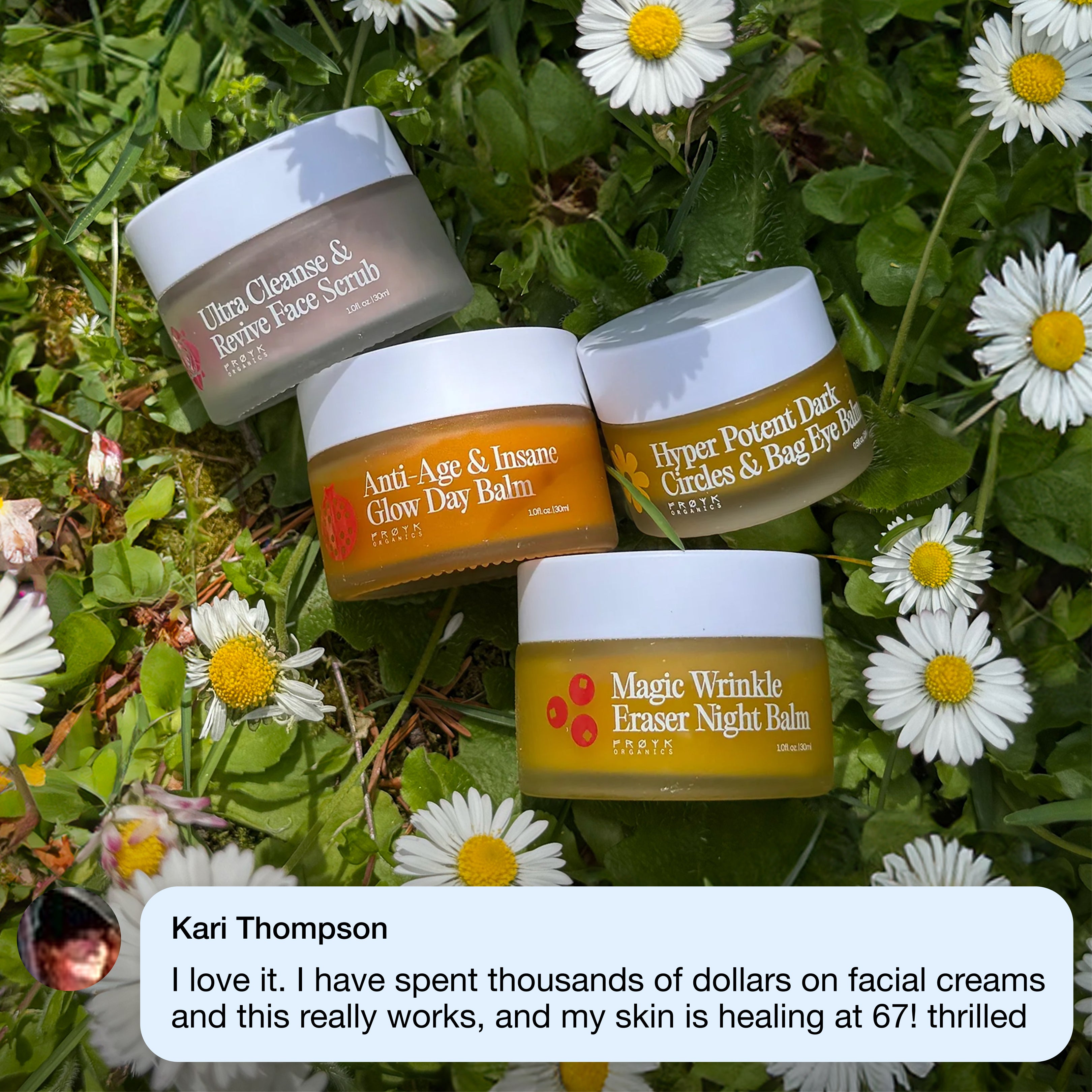
Botaniques arctiques sauvages et cire d'abeille biologique. Zéro eau, zéro parfum synthétique. Quatre baumes dans une routine qui nourrit les lipides de barrière dont dépend une luminosité durable, soutenu par une garantie de remboursement 60 jours.
Découvrir le Système - $11

