 Account


I caught my reflection in the car mirror at 47 and nearly didn't recognize myself. The dark circles I had been blaming on a bad night's sleep had settled in as a permanent feature, and no concealer was fixing them. I had a drawer full of eye creams, each promising the moon, and not one had moved the needle.
Most eye cream guides give you a list of lab actives and leave the biology unexplained. This one starts with the plants Nordic women have reached for across generations, and explains what the clinical research now confirms about why they work. The best eye cream for dark circles is not a single hero ingredient. It is a stack, and the base of that stack is botanical.
What I learned after 47 is that dark circles come in three types, and almost every eye cream on the market treats only one of them. Arnica, chamomile, sea buckthorn, and squalane address all three pathways at the foundation level. Clinical actives like vitamin K, vitamin C, retinaldehyde, and peptides build on top of that foundation when you need reinforcement.
Here is the shape of what follows. You will learn to classify your circles with a 30-second stretch test. You will see why menopause changes the problem at 45 and why your old routine stopped working. Then we walk through each botanical with the clinical research behind it, and build an AM-and-PM stack for your type.
One more framing note before we start. Give this eight to 12 weeks, not two. The pathways respond, but they respond on biology's timeline, not Amazon's.
The Three Types of Dark Circles (And Why Most Eye Creams Fail)
Seventy-eight percent of women over 40 have mixed-type dark circles, which is exactly why the single-ingredient eye cream you bought last year did not work.
Huang and colleagues published the definitive classification in 2018. Vascular circles account for 14 percent of cases, pigmented circles 5 percent, structural circles 3 percent, and mixed types the remaining 78 percent.
If your eye cream targets only pigmentation and your circles are vascular, you are treating the wrong pathway. The cream is not broken. The diagnosis is.
Daroach and Kumaran at PGIMER frame this plainly: accurate etiologic classification is essential before treatment. You cannot lighten what is actually a blood vessel showing through thin skin. You cannot brighten what is actually a hollow casting a shadow.
The stretch test
Stand in front of a mirror in natural light. Gently stretch the skin below your eye outward toward your temple.
If the darkness fades or disappears, your circles are primarily pigmented. If the darkness deepens, they are structural. If the color does not change much but you see a blue or purple tone, they are vascular.
Color by type
Why single-ingredient products fail
Caffeine is a vasoconstrictor. It works on vascular circles and does nothing for pigmentation.
Vitamin C is a tyrosinase inhibitor. It works on pigmented circles and does nothing for hollowing. Retinaldehyde rebuilds collagen, which addresses structural change and is beside the point if your circles are vascular leakage.
Mixed type is the rule, not the exception. Seventy-eight percent means the stack has to match, because one mechanism on its own leaves the other two running untreated.
The women I know who have cleared their dark circles did not find one magic ingredient. They built a stack, and they started with a botanical base that worked on all three pathways at once.
Frøya's botanical stack of arnica, chamomile, sea buckthorn, and squalane was formulated to address each of these three pathways. The sections that follow explain exactly how.
Why Dark Circles Worsen After 45: The Menopause Connection
If your dark circles appeared or worsened after 40, hormones are likely driving the change, not your habits.
The data is specific and, frankly, confronting. Women lose 30 percent of their skin collagen in the first five years after menopause, then roughly 2 percent per year after that. Skin thickness declines by 1.1 percent annually. The periorbital skin, already the thinnest on the body at 0.5 millimeters, is the first to show what is happening underneath.
Estrogen decline drives three structural changes around the eye. Thinner skin makes the underlying capillaries more visible, which intensifies vascular circles. Collagen loss deepens the tear trough and hollows the under-eye area, which creates structural shadow. The malar fat pad shifts downward, which exposes the orbital rim and casts new shadows that did not exist in your thirties.
Dr. Sarah Bonza describes dark circles after 40 as “the first visible sign of perimenopause.” That was the sentence that rearranged my thinking. The circles were not a failure of my skincare. They were a signal from my endocrine system.
What HRT does, and what it does not
Women on hormone replacement therapy show measurable skin thickness increases of 7 to 15 percent over five years. Dr. Sam Ellis notes that topical prescription estrogen is particularly effective for periorbital skin in post-menopausal women. If HRT is on the table for you, the skin benefits are real.
HRT is not the topic of this article. But if you are fighting dark circles without addressing the hormonal engine driving them, you are fighting with one hand tied behind your back.
How squalane fills the gap estrogen left
When periorbital skin thins and the lipid layer depletes, something has to take the place of what estrogen no longer builds. Squalane is a skin-identical lipid. It mirrors the sebum your skin produces less of after 45, and it reduces transepidermal water loss through that thinned barrier.
Squalane does not replace estrogen. It supports what estrogen no longer can, which is a completely different claim and the honest one. Without a functional barrier, every active you layer on top becomes an irritant. With squalane, the barrier holds.
Your skin after 45 is not damaged. It is different, and it needs a different toolkit built around the biology you actually have now.
Arnica and Chamomile: The Botanical Vascular Fix
Most vascular dark circles are not a pigment problem. They are a plumbing problem. And two plants speak directly to that.
Arnica montana is the one almost every European grandmother kept in the medicine cabinet, and the biochemistry explains why. Arnica contains helenalin and a flavonoid complex that together produce a measurable anti-inflammatory effect. Simsek and colleagues ran a randomized controlled trial on post-rhinoplasty patients and showed topical arnica significantly reduced periorbital edema compared to placebo.
Vascular circles often involve slow hemoglobin leakage from fragile capillaries into the surrounding tissue, where iron breaks down into biliverdin and hematoidin, both of which read as blue-purple under thin skin. Arnica improves microcirculation, which helps clear that leaked pigment, and reduces the inflammatory cascade that makes capillaries leaky in the first place.
What arnica can and cannot do
Ryzhaya and Rivers published a review at UBC in 2025 concluding that the evidence for chronic arnica use in aesthetic applications is “inconclusive.” This matters, and I am not going to pretend it does not. Arnica is strongly supported for acute vascular flare-ups and post-procedural bruising. The long-term, daily-use data for cosmetic dark circle applications is still thin.
The honest position is this. Arnica earns its place in the stack for the acute and inflammatory component of vascular circles. It is not a standalone cure for chronic vascular darkness. It is one of three tools the vascular pathway needs.
Chamomile, the anti-inflammatory partner
Matricaria chamomilla contains apigenin, a flavonoid that inhibits NF-kB, the master regulator of the inflammatory response. When capillaries are reactive, flushed, or inflamed, chamomile calms them. Clinically, that shows up as reduced periorbital redness and reduced reactivity to stress, heat, and irritants.
Arnica and chamomile work on the same pathway from slightly different angles. Arnica is the circulation and drainage tool. Chamomile is the inflammatory calm. Together they address what the vascular pathway needs at the botanical level.
Vitamin K: the capillary repair layer
Vitamin K strengthens capillary walls by supporting the clotting factor cascade that seals micro-leaks. When capillary integrity improves, less hemoglobin leaks into surrounding tissue, and less biliverdin and hematoidin accumulate to create that bruised under-eye tone.
A good arnica eye cream gives you the botanical layer that addresses inflammation and microcirculation. The vitamin K layer addresses the vessel walls themselves.
These are not redundant. They are sequential. The plant quiets the fire. The vitamin strengthens the plumbing so the fire stops reigniting. This is also where arnica for under eye bags earns its keep overnight, when the fluid and inflammation accumulated during the day get processed.
Sea Buckthorn and the Pigment Pathway
Brown dark circles are the only type where the solution is almost entirely about what you prevent, not just what you treat.
Pigmentation is an oxidation story. UV exposure, inflammation, and oxidative stress all trigger melanocytes to produce melanin, and in the delicate periorbital skin that pigment deposits easily and clears slowly. By the time you see a brown circle, the melanocyte has already responded to months or years of oxidative load.
Sea buckthorn CO2 extract is the botanical centerpiece of pigment-pathway defense. It carries a dense carotenoid and beta-carotene load that neutralizes the free radicals that would otherwise trigger melanocyte activation, and it delivers omega-7 (palmitoleic acid) that supports barrier repair so the epidermis sheds pigmented cells more efficiently.
Where sea buckthorn fits in the stack
Sea buckthorn is not a direct tyrosinase inhibitor. It does not block melanin production the way vitamin C or alpha arbutin does. Its role is different and complementary. It addresses the oxidative conditions that allow pigmentation to deepen in the first place, and it supports the turnover pathway that allows pigmented cells to cycle off.
The actives that finish what sea buckthorn starts
Vitamin C earns its place here. Dr. Vanita Rattan highlights its dual action: tyrosinase inhibition plus capillary wall stabilization, which means it addresses both the pigment deposit and any vascular component bleeding into a mixed picture. A 1 percent formulation around the eye is effective without being irritating.
Niacinamide supports tone evenness and reduces melanosome transfer from melanocytes to keratinocytes. It pairs well with vitamin C and sea buckthorn. Alpha arbutin is the stubborn-pigmentation tool and earns a spot only if 12 weeks of vitamin C plus sea buckthorn has not moved the circle.
The SPF point is non-negotiable
Melanocyte response to UV intensifies with age. The same sun exposure that produced no visible pigment at 30 produces a visible circle at 55. UV penetrates window glass, which means your drive to work and your seat by the kitchen window are both contributing.
Without daily SPF on the under-eye area, no brightening ingredient can keep up with the pigment you are generating in real time. An under eye wrinkle cream with SPF, or a mineral sunscreen layered over your eye cream, is the intervention that makes every other pigment treatment work.
Squalane, Omega-7, and the Structural Rebuild
Structural dark circles, the grey shadow type, are where topical skincare reaches its limits. They are also where what you put on the skin first matters more than anywhere else.
Structural circles happen because the scaffolding has thinned. Collagen has declined, the dermal matrix has loosened, the tear trough has deepened, and the fat pad has shifted. A shadow falls into the hollow and reads as a dark circle.
Topicals cannot replace volumetric loss, and any article that tells you otherwise is selling something. But topicals can rebuild collagen density at the skin level, thicken the dermis, and reduce the visual depth of the shadow. That is a real and measurable effect, and it is where squalane, sea buckthorn's omega-7, and retinaldehyde each earn their place.
Squalane, functional not cosmetic
Squalane is the stable, hydrogenated form of the squalene your own sebum produces, and it functions like sebum without going rancid. On 0.5 millimeter periorbital skin that is losing its lipid barrier to age, squalane is not a moisturizer in the decorative sense. It is a barrier component.
A functional barrier means the retinaldehyde you apply at night does not trigger the irritation that would otherwise send you back to the bathroom cabinet at week three. Squalane is what makes the clinical stack tolerable on skin already under pressure.
Omega-7 at the structural level
Palmitoleic acid, the omega-7 in sea buckthorn, is the predominant fatty acid in human sebum and helps fill the gap when post-menopausal skin produces less of its own. It does not build collagen directly, but it supports the cellular conditions under which collagen-building ingredients can do their work.
Why retinaldehyde belongs in this stack
Retinaldehyde is one enzymatic step away from retinoic acid, which makes it roughly 10 times faster than retinol while using the same receptor pathway. Kaufman and colleagues ran a 12-week RCT in 2022 published in the Journal of Drugs in Dermatology and reported a 33 percent improvement in fine lines, a 41 percent reduction in undereye darkness, and a 55 percent reduction in puffiness.
The protocol matters. Start at one or two nights per week, buffer with a moisturizer underneath for the first four weeks, and build to three or four nights only once the skin is stable. A best product for under eye wrinkles conversation almost always ends at retinaldehyde if the skin can tolerate it.
Peptides as the retinoid alternative
Not every woman over 45 can use a retinoid around the eye. Dry-eye patients, contact lens wearers, and women with reactive skin often cannot.
Dr. Sam Ellis recommends peptides as a first-line alternative, and Dr. Vanita Rattan's benchmark eye formula anchors at 2 percent peptides for collagen support without retinoid irritation. The effect is slower and gentler than a retinoid, which is often exactly what 0.5 millimeter skin needs.
How much topicals can actually do
Topical ingredients improve structural circles by 20 to 40 percent at best. Pronounced hollows, deep tear troughs, and significant fat pad descent need filler or surgical intervention. The botanical base is not decoration. It is the delivery environment that determines whether every other active you layer on top actually works on this skin at this age.
How to Build Your Botanical Stack
A good stack has three components: the botanical base, the type-specific actives, and SPF. The ratios shift by type. The base does not change.
The base is the foundation that addresses all three pathways at once. Arnica and chamomile for vascular inflammation and capillary reactivity. Sea buckthorn for antioxidant protection and cell turnover. Squalane for barrier support.
This base belongs on every woman's under-eye area regardless of her type, because every type sits on thinning post-45 skin that needs lipid support. The type-specific actives build on top. Here is how the stacks differ.
PM: Botanical base + vitamin K + concentrated arnica overnight
PM: Botanical base + retinaldehyde or bakuchiol
PM: Botanical base + retinaldehyde 0.1% + ceramides to seal
PM: Botanical base + retinaldehyde + ceramides
The benchmark formula
Dr. Vanita Rattan's label-reading guide is worth knowing: peptides 2 percent, glycerin 2 percent, vitamin C 1 percent, ceramides 1 percent, caffeine 0.5 percent, panthenol 0.5 percent, and retinol or retinaldehyde at 0.1 percent. Use this when you evaluate any eye cream on the market. If the formula is missing most of these or hides them near the bottom of the INCI list, it is underpowered.
What to avoid
Fragrance high on the INCI list is an irritant on 0.5 millimeter skin. High alcohol content strips the barrier you are trying to rebuild. Single-hero-ingredient products claim to solve everything with one active, which is almost never true for mixed-type circles.
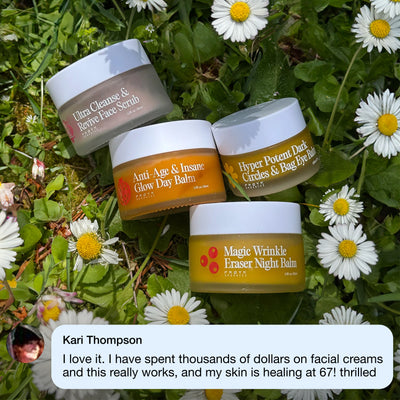
Built on arnica, chamomile, sea buckthorn, and squalane, addressing all three dark circle pathways from the botanical layer up. The product-level version of the framework in this article, formulated for women 45+.
Shop Now – Save 40%How to Apply Eye Cream So It Actually Works
Rice grain. Ring finger. Tap, do not rub. Inner to outer corner.
A rice-grain amount per eye is the correct dose. Over-application produces milia, the white bumps that form when oil and keratin get trapped in pores that cannot clear the load.
Use your ring finger only. It is the weakest finger, and the 0.5 millimeter periorbital skin cannot take the pressure of your index or middle finger without mechanical damage to the collagen you are preserving.
Tap, do not rub. Rubbing damages collagen day after day. Tap the product in with a light bouncing motion until it disappears, moving from inner to outer corner along the orbital bone rather than the lash line.
Common mistakes
Applying full-face retinol near the eye area is the fastest way to irritate periorbital skin. Use eye-specific retinaldehyde at a lower concentration instead.
Quitting after two weeks is the second most common failure. Caffeine works same-day, but retinaldehyde and peptides need eight to 12 weeks. Skipping the AM stack leaves daytime oxidative and UV damage completely unaddressed.
When topicals are not enough
Pronounced hollows need filler, and I would rather say that plainly than waste your money on a cream that cannot fix volume loss. If pigmentation is not responding after 12 weeks of a complete stack with SPF, see a dermatologist. Persistent, asymmetric, or sudden darkness can be systemic, iron-related, or thyroid-related, and it warrants a GP visit rather than another eye cream.