 Account


Ihre Haut hat jahrelang alles vertragen. Dann, irgendwann in den Mittfierzigern, ändern sich die Regeln. Ein neues Serum lässt Ihr Gesicht erröten. Ihre Reinigung beißt zum ersten Mal. Am Abend sehen Ihre Wangen aus, als wären Sie im kalten Wind nach Hause gelaufen – dabei waren Sie es nicht.
Diese Verschiebung hat einen Namen und einen Mechanismus. Blauer Kamille-Öl beantwortet diese Frage seit Jahrhunderten.
Blauer Kamille-Öl, destilliert aus Matricaria recutita (Deutscher Kamille), ist einer der wenigen Pflanzenstoffe, dessen Mechanismus direkt auf die stille Entzündung einwirkt, die reife Haut entwickelt, wenn der Östrogenspiegel fällt. Die tiefe Indigofarbe in der Flasche ist nicht kosmetisch. Es ist Chamazulen, und es ist das beste Qualitätsmerkmal, das Sie an der Regalware erhalten.
Fangen Sie mit der Farbe an. Dieses tiefe Indigo ist, wo die Geschichte des ätherischen Öls für die Haut beginnt, und alles andere – der Mechanismus, die Forschung, die Verdünnungsmathematik – folgt daraus.
Warum Blauer Kamille-Öl tatsächlich blau ist: Chamazulen, Matricin und die Destillationsgeschichte
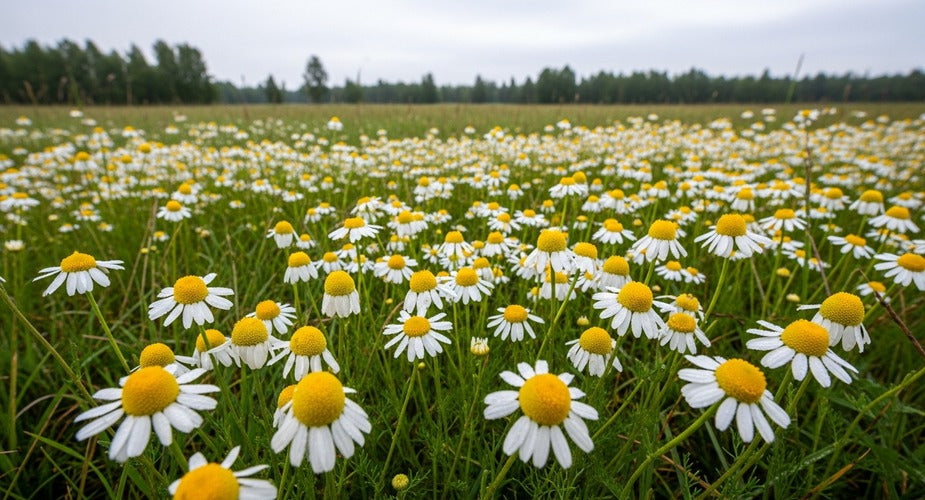
Zerdrücken Sie eine frische Deutscher-Kamille-Blüte zwischen den Fingern und nichts Blaues kommt heraus. Das Pigment existiert in der Pflanze nicht. Chamazulen entsteht in der Destille.
Frische Kamille enthält einen farblosen Vorläufer namens Matricin. Unter Hitze und Druck der Dampfdestillation ordnet sich Matricin zu Chamazulen um – einem tiefen indigofarbenen Sesquiterpen. Je länger und heißer die Destillation (im vernünftigen Rahmen), desto mehr Matricin wird umgewandelt, und desto blauer wird das Öl. Farbe ist keine Vermarktung. Es ist ein lesbares Chemie-Signal.
Im GC-MS-Bericht sieht ein gut destilliertes Öl ungefähr so aus: Alpha-Bisabolol-Oxid A etwa 42%, Chamazulen irgendwo zwischen 2,3% und 21%, und (Z)-Spiroether etwa 8%. Diese Chamazulen-Spanne ist absichtlich breit. Hier trennen sich Premium und Mittelware.
Mehr Chamazulen bedeutet mehr vom Molekül, das auf COX-2 wirkt, plus typischerweise mehr vom Bisabolol-Pool, der NF-kB unterdrückt. Tiefes Indigo in der Flasche deutet auf beides.
Ein Punkt zu flaggen: Guaiazulen. Es ist ein synthetisches Azulen, das in einigen K-Beauty-Formeln verwendet wird und in ppm aufgelistet wird, um beeindruckend auszusehen. Es ist nicht Chamazulen. Es kommt nicht von Matricaria recutita. Das Molekül ist verwandt, die Wirkung nicht gleichwertig, und die ppm-Zahl wird häufig als Prozentsatz missverstanden.
Wenn Sie für therapeutische Wirkung auf reife Haut kaufen, wollen Sie Chamazulen aus dampfdestillierter Deutscher Kamille. Punkt.
Echter Blauer Kamille-Öl riecht medizinisch, leicht bitter, ein bisschen wie Heu. Er riecht nicht süßlich. Er riecht nicht wie Kamillenee. Wenn die Flasche Sie an Bonbons oder grüne Äpfel erinnert, halten Sie wahrscheinlich römische Kamille oder etwas Verfälschtes fest.
Die Farbe zeigt Ihnen, dass die Chemie vorhanden ist. Was sie tut, wenn sie 45+ Haut erreicht, ist die nächste Frage.
Wie Blauer Kamille-Öl auf reifer Haut wirkt: NF-kB, COX-2 und das Inflammaging-Problem
Wenn Kamille einfach "beruhigend" ist, warum reagiert die Haut eines 47-Jährigen ganz anders als die eines 27-Jährigen? Die Antwort liegt in einem einzigen Signalisierungsprotein: NF-kB. Es ist der Grund, warum perimenopausalse Haut sensibler wird, auch wenn sich in Ihrer Routine nichts geändert hat.
Inflammaging ist in einfachen Worten das, was geschieht, wenn der Östrogenspiegel in Ihren Vierzigern sinkt und die zelluläre Signalisierung in Richtung chronische, stille Entzündung kippt. NF-kB, der Hauptschalter für Entzündungs-Genexpression, bleibt länger und häufiger an. Stromabwärts steigen TNF-Alpha, IL-1Beta, IL-6, iNOS und COX-2 alle an. Ihre Haut registriert das als schnelleres Erröten, dünner werdende Barriere, sichtbare Kapillaren, steigende Reizbarkeit.
Alpha-Bisabolol, das etwa 42% des Öls ausmacht, unterdrückt NF-kB direkt. Es dämpft auch genau die Zytokine, die bei Inflammaging auf Hochtouren laufen: TNF-Alpha, IL-1Beta, IL-6, iNOS und COX-2. Eine 2022 Übersichtsarbeit von Ramazani und Kollegen in Life Sciences, zitiert von mehr als 78 nachfolgenden Studien, legt diesen Mechanismus im Detail dar. Alpha-Bisabolol trägt auch FDA-GRAS-Status – eine aussagekräftige regulatorische Grundlage.
Chamazulen macht die andere Hälfte der Arbeit. Es funktioniert als selektiver COX-2-Hemmer – derselbe Signalweg, auf den moderne NSAIDs abzielen, aber ohne das Magentritt-Risiko eines oral eingenommenen Medikaments. Weniger COX-2-Aktivität bedeutet weniger Prostaglandin an der Kapillarwand. Weniger Prostaglandin an der Kapillarwand bedeutet weniger von dem Erröten, das nach einer heißen Dusche, einem Glas Wein zum Essen oder der sechzehnten Hitzewallung der Woche kommt.
Eine dritte Schicht verdient Erwähnung. Quercetin, ein in Kamille vorhandenes Flavonoid, hat sich als stimulierend für Kollagen- und Elastinproduktion erwiesen. Sie beruhigen nicht nur eine überreagierende Signalisierungsumgebung, Sie bringen auch die strukturellen Proteine voran, die dünner wurden, als der Östrogenspiegel den Raum verließ.
Wenn der Mechanismus so spezifisch ist, kann römische Kamille, die im Wesentlichen kein Chamazulen enthält, Deutsche Kamille nicht ersetzen – auch wenn sie oft so verkauft wird.
Blauer Kamille-Öl vs. römische Kamille: Warum Sie das eine nicht für das andere ersetzen können
Zwei Flaschen an der Regalware. Beide sagen ätherisches Kamillenöl. Eine ist hellgelb. Eine ist tiefes Indigo. Kaufen Sie die falsche für empfindliche reife Haut, und Sie werden die entzündungshemmende Wirkung nicht bekommen, die Sie suchen.
Die Chemie erzählt die Geschichte am schnellsten. Deutsche Kamille (Matricaria recutita) enthält nach der Destillation zwischen 2,3% und 21% Chamazulen. Römische Kamille (Chamaemelum nobile) enthält im Wesentlichen 0%. Die gesamte COX-2- und NF-kB-Geschichte aus dem vorherigen Abschnitt basiert auf Molekülen, die in römischer Kamille einfach nicht in bedeutsamen Konzentrationen vorkommen.
Farbe ist der erste Filter. Deutsch ist tiefes Indigo, blauschwarz, fast wie Tinte im Tropfer. Römisch ist hellstrohgelb. Wenn Sie "Blauer Kamille-Öl" bestellt haben und ein gelbes Öl erhalten, haben Sie die falsche Pflanze erhalten, nicht eine schlechte Charge.
Geruch ist der zweite Filter. Deutsche Kamille riecht medizinisch, heuartig, leicht bitter. Römische Kamille riecht süß und deutlich nach grünem Apfel. Römisch wird für Aromatherapie-Mischungen bevorzugt, besonders für Angst und Schlaf, wegen dieses weicheren Profils. Für Hautenttzündungsarbeit wollen Sie die Bittere.
Römische Kamille hat ihre Tugenden. Sie ist reich an Estern, besonders Angelaten, die ihr krampflösende und nervenstärkende Eigenschaften geben. Nützlich in anderen Kontexten. Nicht der Molekülsatz, den Sie brauchen, wenn Ihre Wangenkapillaren durch dünnere Haut scheinen und Ihr Kiefer nach dem Essen errötet.
Preis ist ein weiteres Zeichen. Echter Blauer Kamille-Öl kostet normalerweise $30 bis $80 oder mehr pro 5 bis 10 ml von einem seriösen Lieferanten. Wenn Sie ein "Blauer Kamille-Öl" für $12 pro 15 ml finden, stimmt etwas nicht: das Etikett, die Beschaffung oder die Konzentration.
Fordern Sie das lateinische Binomial auf der Flasche: Matricaria recutita oder Matricaria chamomilla (Synonyme für dieselbe Pflanze). "Ätherisches Kamillenöl" allein sagt Ihnen nicht, welche Art sich innen befindet.
Wenn die Chemie so unterschiedlich ist, sind die Klinischen Studien, die es wert sind, zitiert zu werden, die mit Deutscher Kamille. Und diese existieren.
Was die klinische Forschung tatsächlich zeigt: Ekzeme, atopische Dermatitis und empfindliche Haut
In einer Phase-III-randomisierten kontrollierten Studie zeigte eine Kamille-Creme leichte Überlegenheit gegenüber 0,5% Hydrocortison bei der Behandlung von atopischem Ekzem über zwei Wochen. Die meisten gehen davon aus, dass Hydrocortison immer gewinnt. Die Daten sagen etwas anderes – zumindest in diesem engen Vergleich.
Diese Studie ist Patzelt-Wenczler 2000 (PubMed PMID 10799352). Das Produkt war Kamillosan-Creme, hergestellt aus einer speziell allergenarmen Kamillesorte namens Manzana. Über zwei Wochen Behandlung bei Patienten mit atopischem Ekzem schnitt die Kamille-Zubereitung bei den gemessenen Ergebnissen leicht besser ab als 0,5% Hydrocortison. "Leichte Überlegenheit" ist der vorsichtige Satz, und er verdient diese Vorsicht. Die Richtung des Ergebnisses zählt.
Mechanistische Forschung füllt den Rest. Lee und Kollegen (2010, PMC2833428) zeigten, dass ätherisches Deutsche-Kamille-Öl Th2-Typ-Immun-Zytokine in einem Mausmodell der atopischen Dermatitis reduzierte. Das entspricht der NF-kB- und Zytokine-Geschichte aus dem vorherigen Abschnitt fast Zeile für Zeile. Wang und Kollegen (2021, PMC8515037) fanden, dass flüchtiges Kamillenöl Ekzemsymptome durch mehrere gleichzeitige Signalwege reduzierte – was wichtig ist, denn Hautentzündung ist selten ein einzelnes Problem.
Jetzt die ehrliche Einschränkung. Dies sind Ekzem- und atopische-Dermatitis-Studien. Sie sind keine Studien über perimenopausalse Rötung oder Inflammaging-getriebene Reizbarkeit. Der Fall für Blauen Kamille-Öl auf 45+-Haut ist eine Extrapolation aus gemeinsamen Mechanismen: NF-kB-Unterdrückung, COX-2-Hemmung, Zytokine-Dämpfung. Die molekularen Ziele überlappen sich. Die klinischen Populationen überlappen sich noch nicht vollständig. Ich sage das lieber klar, als zu viel zu versprechen.
Die meisten Menschen vergeuden dieses Öl im Anwendungsschritt.
Wie Sie Blauer Kamille-Öl auf reifer Haut verwenden: Verdünnung, Trägeröle und Routine-Platzierung
Für reife, empfindliche oder perimenopausalse Haut verdünnen Sie Blauer Kamille-Öl auf 0,5% bis 1%. Das sind ein bis zwei Tropfen pro 30 ml Trägeröl. Nicht 2%. Nicht "ein paar Tropfen und schauen".
Die untere Spanne ist in unserem Alter aus einem bestimmten Grund wichtig. Das Stratum Corneum ist dünner. Die Barriere ist durchlässiger. Inflammaging hat die Basis-Reizbarkeit bereits erhöht. Bei 2% Verdünnung können Sie den Sting-and-Flush-Reflex, den Sie beruhigen möchten, wirklich auslösen. Bei 0,5% bis 1% bekommen Sie die therapeutische Wirkung ohne Aufraubung der Reizbarkeit.
In messbaren Begriffen landen drei bis vier Tropfen ätherisches Blauer Kamille-Öl in 30 ml Trägeröl genau in diesem 0,5% bis 1% Band. Ein vernünftiger Ausgangspunkt.
Die Trägeröl-Mischung ist fast so wichtig wie die Kamille selbst. Für reife Haut verwende ich 35% Hagebutte, 35% Arganöl und 30% Jojoba. Hagebutte bringt Linolsäure und Vitamin-A-Vorstufen mit. Arganöl liefert Tocopherole. Jojoba ist technisch ein Wachsester, strukturell ähnlich unserem eigenen Talg, also hilft es der Mischung, sich ohne fettiges Gefühl zu glätten.
Mischen Sie 30 ml dieses Trios in eine dunkle Glastropfflasche, dann fügen Sie drei bis vier Tropfen Blauer Kamille-Öl hinzu. Beschriften Sie sie. Verschließen Sie sie fest.
Abendroutine, Schritt für Schritt:
- Sanfte Reinigung. Keine schäumenden Tenside auf empfindlicher Haut in der Nacht.
- Kamille-Hydrolat oder ein pH-Toner leicht auf noch feuchte Haut getupft.
- Drei bis fünf Tropfen der Blauer Kamille-Öl-Mischung, eingeklopft (nicht gerieben) auf noch feuchte Haut.
- Nachtcreme oder Balsam darüber zum Versiegeln.
Der Abend ist das bevorzugte Zeitfenster aus zwei Gründen. Chamazulen ist lichtempfindlich, und empfindliche Haut profitiert von der längeren Einwirkungszeit über Nacht. Am Morgen, wenn Sie es verwenden möchten, schichten Sie es unter mineralischem Sonnenschutz, nicht chemischem. Viele Frauen über 45 finden, dass die Anwendung nur abends ausreicht.
Bevor Sie im ganzen Gesicht anfangen, machen Sie einen Allergietest. Ein Tropfen der verdünnten Mischung auf die Innenseite des Unterarms. Warten Sie 24 Stunden. Wenn nichts passiert, versuchen Sie zwei Nächte lang am Kiefer. Erst dann zum ganzen Gesicht. Dieser Schritt ist nicht verhandelbar auf empfindlicher Haut, und er kostet drei Tage, um drei Jahre Ihrer Routine zu schützen.
Jeden Abend bei 0,5% bis 1% ist für die meisten okay. Wenn Sie Erröten, Kribbeln oder Hitze spüren, gehen Sie auf jeden zweiten Abend über. Lösen Sie eine Reaktion nicht, indem Sie zu einer höheren Verdünnung übergehen. Lösen Sie sie, indem Sie der Haut mehr Erholungsraum geben.
Das einzige, das zwischen dieser Routine und den Ergebnissen steht, ist der Kauf eines Öls, das wirklich das enthält, was die Bezeichnung verspricht.
Echten Blauer Kamille-Öl kaufen: Qualitätsmerkmale, Beschaffung und Lagerung
Wenn Sie Blauer Kamille-Öl kaufen, zählen vier Etikett-Checks, drei Flaschen-Checks und eine Lagerungsregel. Wenn Sie diese richtig machen, haben Sie die meiste Arbeit geleistet.
Auf dem Etikett suchen Sie nach:
- Lateinisches Binomial. Matricaria recutita oder Matricaria chamomilla. Nicht nur "Kamille".
- Dampfdestilliert. Lösungsmittel-extrahierte Absolues sind ein anderes Produkt mit anderer Chemie.
- Herkunftsland. Ungarn gilt allgemein als Premium für Blauer Kamille-Chemotypen. Ägypten und Deutschland produzieren auch ausgezeichnete Öle.
- GC-MS-Bericht verfügbar. Jeder seriöse Lieferant stellt einen chargenspezifischen Gaschromatographie-Bericht mit dem angegebenen Chamazulen-Prozentsatz zur Verfügung. Wenn sie sich weigern, einen zu teilen, gehen Sie weiter.
In der Flasche suchen Sie nach:
- Tiefe Indigo bis Blauschwarz-Farbe.
- Medizinischer, bitter-heuartiger Duft.
- Dünne Viskosität. Wenn es dick und sirupartig ist, halten Sie möglicherweise eine Absolue, nicht ein reines ätherisches Öl.
Bei Preis rechnen Sie mit $30 bis $80 oder mehr pro 5 bis 10 ml von einem seriösen Lieferanten. Wenn eine Flasche deutlich billiger ist, behandeln Sie das als Warnsignal und untersuchen Sie die Beschaffung, bevor Sie dem Etikett vertrauen.
Die Lagerung ist einfach und wichtig. Dunkle Glasflasche. Kühler Schrank, weg vom Heizkörper und Fenster. Verschließen Sie fest nach jedem Gebrauch. Die Haltbarkeit beträgt ein bis zwei Jahre nach dem Öffnen. Wenn das Öl von Indigo zu Grün oder Braun wechselt, ist Chamazulen oxidiert und das Öl hat die Potenz verloren, die Sie bezahlt haben. Verwenden Sie es, aber erwarten Sie nicht die ursprüngliche Wirksamkeit.
Ein Öl dieser Spezialität verdient es, bewusst gekauft und gelagert zu werden.