 Account


Sie kennen das Ritual. Feuchtigkeitscreme auftragen, sich eine Stunde lang großartig fühlen, dann beobachten, wie Ihre Haut bis zur Mittagspause wieder straff und ausgetrocknet wird. Wenn Sie über 40 sind, wird dieser Kreislauf intensiver, da Ihre Hautbarriere physisch dünner wird und Feuchtigkeit schneller verliert als noch vor zehn Jahren. Standard-Lotionen, die mit Wasser und Konservierungsstoffen beladen sind, halten nicht Schritt.
Bienenwachs für die Haut ist kein Trend. Es ist keine Entdeckung von 2026. Archäologen haben chemisch stabiles Bienenwachs in ägyptischen Gräbern gefunden, die Tausende von Jahren alt sind. Die Römer schätzten es so sehr, dass sie einmal 100.000 Pfund davon von besiegten Korsen anstelle von Gold einforderten. Es hat überlebt, weil es funktioniert. Eine Literaturanalyse von 2023 von Forschern der UC Davis (Nong et al., Journal of Cosmetic Dermatology) bestätigte, was Naturprodukte-Formulierer seit Jahrhunderten wissen: Bienenwachs fungiert gleichzeitig als drei Dinge. Okklusive, Humektans und Emollient. Diese dreifache Wirkung ist selten in einem einzelnen Inhaltsstoff, ob natürlich oder künstlich.
Jeder dieser sieben Bienenwachs-Hautvorteile basiert darauf, wie Bienenwachs tatsächlich mit der Biologie Ihrer Haut interagiert, besonders wenn Sie mit trockener, reifer oder empfindlicher Haut umgehen, die mehr braucht als das, was eine Standard-Wasser-basierte Lotion liefern kann.
1. Es sperrt Feuchtigkeit ein, ohne Ihre Haut zu ersticken
Die meisten Feuchtigkeitscremes tun eines von zwei Dingen: Sie fügen Ihrer Haut Wasser zu oder halten Wasser darin ein. Bienenwachs tut beides. Diese Unterscheidung ist wichtiger, als die meisten Hautpflege-Marken Sie wissen lassen möchten.
Die Übersichtsarbeit von Nong et al. von 2023 erläuterte die drei unterschiedlichen Rollen, die Bienenwachs auf Ihrer Haut spielt. Erstens ist es semi-okklusiv und bildet eine Barriere, die den transepidermalen Wasseverlust (TEWL) minimiert, den technischen Begriff für Feuchtigkeit, die durch die Hautoberfläche entweicht. Zweitens ist es ein Humektans, das aktiv Feuchtigkeit aus der Luft zu Ihrer Haut zieht. Drittens ist es ein Emollient, das alles erweicht und glättet, was es berührt.
Denken Sie an Ihre Haut wie an einen Eimer mit winzigen Löchern. Hydrierende Seren und Cremes gießen Wasser hinein, aber ohne einen Deckel verdunstet diese Feuchtigkeit. Bienenwachs ist der Deckel. Im Gegensatz zu Vaseline, die ein luftdichtes Siegel schafft, das die Haut ersticken kann, bildet Bienenwachs eine atmungsaktive Barriere. Feuchtigkeit bleibt erhalten. Ihre Haut funktioniert noch normal.
Bienenwachs hat auch einen Vorteil bei der physischen Stabilität. Es schmilzt bei 62 bis 64 Grad Celsius, weit über der Körpertemperatur und der Sommerhitze. Kokosnussöl schmilzt bei 24 Grad Celsius. Ihre Bienenwachs-Barriere bleibt intakt, wenn andere natürliche Alternativen bereits zusammengebrochen sind. Reine Öle können sich vor der Absorption an Kleidung reiben. Eine Bienenwachsmischung bleibt länger auf der Haut und liefert den ganzen Tag über länger anhaltende Hydratation, anstatt innerhalb weniger Stunden zu verblassen.
Wenn Ihre Haut die Feuchtigkeitscreme aufnimmt und eine Stunde später um mehr bittet, ist das Problem nicht Hydratation. Es ist Retention. Sie gießen Wasser in diesen undichten Eimer ohne Deckel. Bienenwachs löst die Retentionshälfte der Gleichung.
2. Es stärkt eine dünner werdende Hautbarriere nach 40
Wenn Ihre Haut in Ihren 40ern deutlich trockener oder reaktiver wurde, ist das keine Täuschung. Ihre Hautbarriere ist physisch schwächer als vor zehn Jahren, und das ändert alles, was Ihre Hautpflege tun muss.
Bienenwachs adressiert dies direkt, indem es eine semi-okklusive Schicht bildet, die nachmacht, was die schwächelnde Barriere alleine nicht mehr tun kann. Es hält Feuchtigkeit ein, während es gleichzeitig neue Feuchtigkeit aus der umgebenden Luft durch seine Humektans-Aktion zieht. Die Literaturanalyse von Nong et al. von 2023 kam zu dem Ergebnis, dass Bienenwachs „die Hautbarriere unterstützt" und als „kostengünstiger, natürlicher Inhaltsstoff" für die Hautpflege dienen kann. Für ein Peer-Review-Team der UC Davis Dermatologie ist das eine gemessene, aber aussagekräftige Empfehlung.
Die reale Erfahrung entspricht der Forschung. Ein Rezensent, der Jahre damit verbrachte, anhaltende Gesichtstrockenheit zu beheben, beschrieb eine Kombination aus Bienenwachs, Talg und Honig als „den heiligen Gral" nach langer Zeit mit Produkten, die „einfach nicht funktionieren oder meine Haut sogar verletzen".
Best für: trockene, reife oder postmenopausale Haut, die eine Barriere-Verstärkung benötigt. Die Verdünnung, die mit dem sinkenden Östrogen kommt, macht Bienenwachs in der Hautpflege besonders wertvoll während dieser Phase. Überspringen, wenn: Ihre Haut natürlicherweise fettig ist und Sie unter 30 sind. Sie benötigen wahrscheinlich noch keinen okklusivenBoost.
3. Das Vitamin A in Bienenwachs unterstützt Kollagen, aber es ist kein Retinol
Jeder Bienenwachs-Hautpflege-Artikel erwähnt Vitamin A und Kollagen im gleichen Atemzug. Was sie auslassen: Das Vitamin A in Bienenwachs ist kein Retinol, und die Wirkung ist viel subtiler als das, was Sie von einem verschreibungspflichtigen Retinoid bekommen würden.
Unraffiniertes gelbes Bienenwachs behält Vitamin A in Form eines Retinol-Vorläufers. Angelina Swanson von aos Skincare beschreibt die Wirkung als Aufhellung der Haut, Erweichung feiner Linien und Stimulierung der Kollagenproduktion „ohne das Reizungsrisiko von pharmazeutisch starken Retinoiden". Für Haut, die auf klinisch starkes Retinol mit Peeling und Rötung reagiert, ist diese Sanftheit der Punkt.
Ein wichtiges Detail, das die meisten Leitfäden völlig überspringen. Weißes oder gebleichtes Bienenwachs verliert die meisten seiner Vitamin-A-Mengen während der Verarbeitung. Wenn die Kollagen-Unterstützung wichtig für Sie ist, wählen Sie unraffiniertes gelbes Bienenwachs. Die gelbe Farbe ist ein sichtbarer Indikator dafür, dass die Nährstoffe noch intakt sind.
Denken Sie an Bienenwachs-Vitamin A als tägliche Wartung, nicht als Renovierung. Es ersetzt Ihr Retinol-Serum nicht, aber es fügt jeder Anwendung eine sanfte Kollagen-Unterstützungsebene hinzu. Für Frauen, deren Haut auf klinisches Retinol mit Abschuppung und Reizung reagiert, ist dieser sanftere Weg oft derjenige, der tatsächlich konsistent verwendet wird. Und Konsistenz ist das, was Ergebnisse liefert.
4. Bienenwachs vs. Vaseline: Der Umstieg auf saubere Inhaltsstoffe
Wenn Sie nach einem einzigen Austausch suchen, der Erdöl aus Ihrer Hautpfleggeroutine entfernt, ohne Feuchtigkeit zu opfern, ist Bienenwachs die direkteste Ersatz.
Der Vergleich ist direkt, sobald Sie über das Preisschild hinausblicken. Bienenwachs schafft eine atmungsaktive Barriere, enthält Vitamin A und Propolis, ist biologisch abbaubar und funktioniert sowohl als Humektans als auch als Okklusive. Es verbessert aktiv Ihre Haut, während es sie schützt.
Vaseline schafft ein luftdichtes, nicht atmungsaktives Siegel. Es ist ein Erdöl-Raffinerie-Nebenprodukt. Wenn es nicht stark raffiniert ist, kann es polyzyklische aromatische Kohlenwasserstoffe (PAK) enthalten, eine Klasse von Verbindungen, die als krebserregend eingestuft sind. Weil es die Haut vollständig verschließt, beschreiben einige Formulierer die Langzeitwirkung als „Hautersticken", wo die Haut von dem Produkt abhängig wird, anstatt ihre eigene Barriere zu stärken. Ihre Haut hört auf, ihre eigenen Schutzlipide zu produzieren, wenn ein externes Siegel die Arbeit auf unbestimmte Zeit erledigt.
Die ehrliche Nuance: Vaseline ist billiger und schafft ein stärkeres okklusivaes Siegel. Für stark rissige, trockene oder verletzte Haut, bei der maximale Okklusion die Priorität ist, ist Paraffin wirksam. Ein Dermatologe, der einen Patienten mit tiefen Fersenrissen behandelt, wird Bienenwachs nicht zuerst greifen.
Für tägliche Gesichtsfeuchtigkeitspflege und allgemeine Körperpflege ist Bienenwachs die bessere Wahl, und ein Klassiker der natürlichen Hautpflege. Es schützt und hydratiert, ohne Abhängigkeit zu schaffen oder die natürliche Funktion Ihrer Haut zu blockieren. Bienenwachs ist auch biologisch abbaubar und nachhaltig gewonnen, was Vaseline nicht ist. Im Laufe von Monaten der Anwendung unterstützt eine atmungsaktive Bienenwachs-Barriere die eigene Lipidproduktion Ihrer Haut, anstatt sie zu ersetzen.
Für tägliche Gesichtsfeuchtigkeitspflege: Bienenwachs. Für rissige Fersen über Nacht: Beides funktioniert, aber Vaseline ist billiger. Für saubere Inhaltsstoff-Seelenfrieden: Bienenwachs, ganz klar.
5. Es beruhigt Ekzeme, Psoriasis und gereizte Haut
Ein Dermatologie-Forscher testete eine einfache dreistoffliche Mischung an Patienten mit Ekzemen, Psoriasis und Pilzinfektionen. Bienenwachs, Honig und Olivenöl. Es funktionierte.
Der Mechanismus ist doppelt. Propolis-Spuren in Bienenwachs hemmen Staphylococcus aureus und Candida albicans, zwei Organismen, die entzündliche Hauterkrankungen verschlimmern. Diese Bakterien gedeihen auf kompromittierter Haut, und Propolis unterbricht ihre Fähigkeit, sich zu besiedeln. Gleichzeitig bietet D-002, eine Gruppe von Bienenwachs-Alkoholen, die von Ravelo et al. (2011, Journal of Natural Medicine) untersucht wurden, entzündungshemmende Aktivität, die Rötung und Schwellungen reduziert. Nong et al. wiesen speziell darauf hin, dass Bienenwachs hilft, „Überwuchs normaler Hautflora" zu adressieren, das mikrobielle Ungleichgewicht, das viele chronische Hauterkrankungen antreibt.
Das ist nicht nur feuchtigkeitsspendend. Es ist antimikrobielle und entzündungshemmende Aktion, die zusammen auf kompromittierter Haut wirkt. Die meisten handelsüblichen Ekzem-Cremes verlassen sich auf einen einzigen Mechanismus. Eine einfache Bienenwachs für die Haut Mischung greift das Problem von zwei Richtungen gleichzeitig an.
Wenn Sie Ekzem- oder Psoriasis-Schübe bewältigen, versuchen Sie ein einfaches Bienenwachs-, Honig- und Olivenöl-Balsam auf betroffenen Bereichen vor dem Schlafengehen. Es ist kein Ersatz für verschreibungspflichtige Behandlung, aber die klinische Evidenz unterstützt es als komplementären Ansatz.
6. Hellt Bienenwachs die Haut auf? Was die Forschung tatsächlich zeigt
Suchen Sie nach „Bienenwachs zur Hautaufhellung" und Sie werden Dutzende von Artikeln finden, die implizieren, dass es die Haut aufhellt. Die eigentliche Forschung erzählt eine andere Geschichte.
Bienenwachs hat keine Tyrosinase-hemmenden Eigenschaften. Tyrosinase ist das Enzym, das Melanin produziert, und es zu blockieren ist, wie echte hautaufhellende Inhaltsstoffe (wie Vitamin C, Kojisäure und Arbutin) funktionieren. Bienenwachs tut das nicht. In der einen Studie, die Bienenwachs mit Hautaufhellung verband (Khan et al. 2013, PMC3834707), wurde Bienenwachs zu 7 % als Cremegrundlage verwendet - ein Träger. Das aktive Aufhellen kam von Cassia fistula und Hippophae rhamnoides Pflanzenextrakten, nicht vom Bienenwachs selbst.
Was kann also Bienenwachs für den Hautton tun? Durch die Verbesserung der Barrierengesundheit, tiefe Hydratation und Oberflächentextur trägt Bienenwachs zu einem hellerem, gleichmäßigerem Aussehen im Laufe der Zeit bei. Gesunde, gut hydratierte Haut reflektiert Licht gleichmäßiger, weil die Oberfläche glatter ist und Zellen prall sind, anstatt geschrumpft. Dies schafft eine natürliche Leuchtkraft, die nichts mit Pigmentveränderung zu tun hat. Trockene, schuppige Haut sieht matt aus, egal wie Ihr tatsächlicher Hautton ist. Die Verbesserung ist real, aber sie kommt von Hydratation und Barriere-Reparatur, nicht von Melanin-Reduktion.
Bienenwachs wird Ihre Haut nicht aufhellen. Aber durch die Wiederherstellung der Barrierengesundheit und das Sperren von Feuchtigkeit gibt es Ihrer Haut ein helleres, gleichmäßigeres Aussehen - was eigentlich das ist, was die meisten Menschen wünschen, wenn sie nach Hautaufhellung suchen. Diese Unterscheidung ist wichtig.
7. DIY Honig- und Bienenwachs-Gesichtscreme-Rezept
Sie können eine Gesichtscreme mit besseren Inhaltsstoffen als die meisten Warenhaus-Feuchtigkeitscremes für unter 15 Dollar herstellen.
Dieses Honig- und Bienenwachs-Gesichtscreme-Rezept stammt von Charlotte Anderson, einer Master Beekeeper bei Carolina Honeybees. Sechs Kern-Inhaltsstoffe, jeder für eine bestimmte Funktion ausgewählt.
Inhaltsstoffe
- 1/4 oz (3g) gelbe Bienenwachs-Pellets
- 1/4 Tasse Kakaobutter
- 1/4 Tasse Sheabutter
- 1 EL JOJOBAÖL
- 1 EL KOKOSNUSSÖL
- 1 TL roher Honig
- 5 bis 6 Tropfen Vitamin-E-Öl (optional)
- 15 Tropfen ätherisches Teebaumöl (optional)
Anleitung
- Stellen Sie ein Wasserbad auf und schmelzen Sie zuerst das Bienenwachs. Es hat den höchsten Schmelzpunkt, also braucht es die meiste Zeit.
- Sobald es größtenteils flüssig ist, fügen Sie die Kakaobutter, Sheabutter, Kokosnussöl und Jojobaöl hinzu. Rühren Sie, bis es vollständig vermischt ist.
- Vom Herd nehmen. Fügen Sie den rohen Honig hinzu (nur 1 Teelöffel - Honig ist wasserlöslich und separiert, wenn Sie zu viel verwenden), dann die Vitamin-E- und Teebaumöle, wenn Sie diese verwenden.
- Häufig umrühren, während die Mischung abkühlt. Dies hält den Honig gleichmäßig verteilt, anstatt sich am Boden zu sammeln.
- Sobald es halbfest ist, füllen Sie es in ein Glas mit breiter Öffnung und festem Deckel.
Tragen Sie eine erbsengroße Menge nachts auf und vermeiden Sie den Augenbereich. Zu weich? Schmelzen Sie erneut auf und fügen Sie etwas mehr Bienenwachs hinzu. Zu hart? Reduzieren Sie das Bienenwachs im nächsten Batch. Lagern Sie versiegelt bei Raumtemperatur für mehrere Monate. Werfen Sie weg, wenn sich ein ranziger Geruch entwickelt. Machen Sie einen Patch-Test auf Ihrem inneren Unterarm für 24 bis 48 Stunden, bevor Sie die volle Gesichtsmasse anwenden.
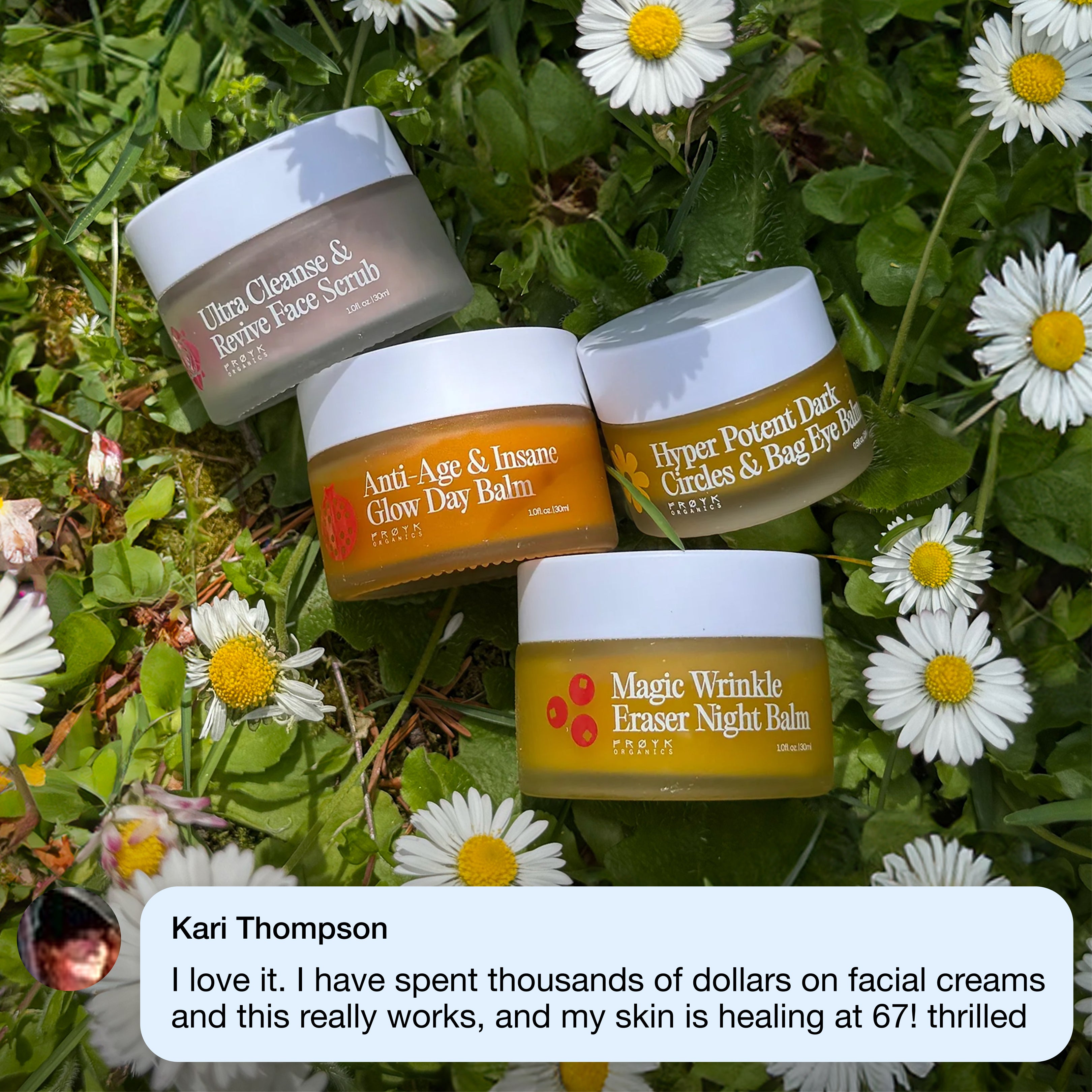
Arktische Wildpflanzen und Bio-Bienenwachs. Kein Wasser, keine künstliche Duftstoffe. Vier konzentrierte Balsame, die empfindliche, reaktive Haut beruhigen und nähren, gestützt durch eine 60-Tage-Geld-zurück-Garantie.
Kaufen Sie das System heute