 Account


Jahrelang wachte ich um 3 Uhr morgens auf, Herz rennend, Gedanken rennend. Ich nahm an, es wäre nur Hormone, Perimenopause eben. Was ich nicht wusste: Jedes Aufwachen kam mit einem Cortisolspike, und dieses Cortisol baute meine Haut leise ab, während ich an die Decke starrte.
Die meisten Artikel über Ashwagandha-Vorteile für die Haut recyceln die gleichen fünf Punkte, ohne den Mechanismus zu erklären oder warum diese Pflanze nach 45 Jahren besonders interessant ist. Ich möchte das anders machen.
Ich werde behandeln, was Cortisol tatsächlich mit der Haut macht, warum Frauen ab 45 es stärker spüren, was die topische Forschung in echten Zahlen zeigt, und wie man einen ernst zu nehmenden Ashwagandha-Hautpflegestoff von einem Marketing-Stoff unterscheidet.
Am Ende wissen Sie genau, was Ashwagandha für Ihre Haut kann und nicht kann, auf welchem Zeitrahmen, und worauf Sie auf einem Etikett achten sollten.
Wie Cortisol die Haut leise schädigt: Der Mechanismus, den niemand erklärt
Ihre Haut enthält eine Familie von Enzymen namens Matrixmetalloproteinasen (MMPs). Unter normalen Bedingungen sind sie ein Wartungsteam, das beschädigtes Gewebe abbaut, damit neues Kollagen es ersetzen kann. Chronisches Cortisol verwandelt sie in ein Abrissteam.
Die Kette läuft so ab. Chronischer Stress erhöht Cortisol. Cortisol reguliert MMP-1, MMP-3 und MMP-9 hoch. Diese Enzyme bauen Kollagen I, Kollagen III und Elastin ab. Das sichtbare Ergebnis ist Festigkeitsverlust, Fältchen und Erschlaffung, die scheinbar "aus dem Nichts" auftaucht.
Das ist erst die halbe Geschichte. Cortisol unterdrückt auch Fibroblasten, die Zellen, die für die Produktion neuen Kollagens verantwortlich sind. Sie verlieren auf beiden Seiten gleichzeitig: mehr Abbau, weniger Produktion, in derselben Haut.
Hier kommt Ashwagandha ins Spiel. Die aktive Wirkstoffklasse, Withanolide, moduliert entzündliche Signalwege und MMP-Aktivität und wirkt als Antioxidans, das die reaktiven Sauerstoffspezies neutralisiert, die Cortisol-getriebene Entzündung erzeugt.
Das ist, wie ein Inhaltsstoff Festigkeit, Ton und Barrierenresilienz gleichzeitig berührt. Nicht, weil es "alles tut", sondern weil es upstream in einer Kaskade eingreift, die mehrere downstream-Symptome antreibt.
Das passiert jedem mit chronisch erhöhtem Cortisol. Für Frauen in ihren mittleren Vierzigern und darüber kommt ein zweiter Mechanismus oben drauf, und er ändert alles daran, warum Ashwagandha gerade jetzt wichtig ist.
Warum Ashwagandha nach 45 anders wirkt: Der Östrogen-Cortisol-Doppelschlag
Wenn deine Haut schneller verändert hat als deine Hautpflege-Routine mithalten konnte, bildest du dir das nicht ein. Etwas Besonderes passiert in den Jahren rund um die Menopause, und es ist nicht subtil.
Östrogen signalisiert über ERβ-Rezeptoren in Fibroblasten, um die Kollagensynthese aufrechtzuerhalten. Wenn Östrogen sinkt, wird dieses Signal schwächer und die Produktion verlangsamt sich. Schnell.
Das ist die Östrogenseite. Jetzt lege Cortisol oben drauf. Sinkendes Östrogen stört auch die HPA-Achsen-Regulierung. Cortisolmuster werden weniger stabil, Spitzen werden höher, und die Erholung dauert länger. Das Aufwachen um 3 Uhr ist nicht zufällig. Es ist Biologie.
Genau in dem Moment, in dem die Kollagenproduktion verlangsamt wird, wird der Kollagenabbau beschleunigt.
Für diese Zielgruppe ist Ashwagandha auf beiden Seiten der Gleichung interessant. Topisch berücksichtigt die Withanolid-getriebene Antioxidans- und MMP-modulierende Aktivität die Abbauseite. Oral zeigt klinische Arbeit mit medizinischer Überwachung, dass Ashwagandha Cortisol um etwa 25% reduziert (240 mg/Tag für 8 Wochen).
Dr. Stacy Sims weist darauf hin, dass Ashwagandha auch die Empfindlichkeit von Östrogenrezeptoren bei peri- und postmenopausalen Frauen modulieren kann, was teilweise erklärt, warum es in diesem Gespräch häufiger auftaucht als andere Adaptogene. Ein Vorbehalt: Wenn du Schilddrüsenmedikamente nimmst, sprich mit deinem Arzt, bevor du orales Ashwagandha hinzufügst. Es gibt eine echte Wechselwirkung zu berücksichtigen.
Das ist die Zielgruppe, für die Ashwagandha praktisch gebaut wurde. Jetzt schau dir an, was die topische Forschung wirklich zeigt.
Was die topische Forschung wirklich zeigt: Die 60-Tage-klinische Studie
In einer 60-Tage-randomisierten kontrollierten Studie mit einer Lotion, die 8% standardisiertes Ashwagandha-Extrakt enthielt, erhöhte sich die Hautfeuchtigkeit um 20,66%. Nicht aus einer Marketing-Präsentation. Aus einer veröffentlichten, placebokontrollierten Studie (PMC10017910).
Drei gemessene Ergebnisse, jedes in klaren Worten:
- Feuchtigkeit +20,66%: vollere, weniger runzelige Haut
- Elastizität +16,34%: die Spannkraft, die mit dem Alter verblasst
- Transepidermaler Wasserlust (TEWL) -15,12%: stärkere Barriere, weniger Feuchtigkeit entweicht
Diese drei Messungen zusammen beschreiben die "Ich sehe erholter aus"-Qualität. Nicht dramatisch, nicht sofortige Straffung, aber messbare strukturelle Verbesserung bei den Parametern, die für Haut wichtig sind, die sich belebt anfühlt und aussieht.
Der ehrliche Vorbehalt: Das ist eine Studie, ein Extrakt (KSM-66), in einer Konzentration. Das ist keine Schwäche. Es ist ein echtes, methodisch solides Datenpunkt, mehr als die meisten pflanzlichen Wirkstoffe in der veröffentlichten Literatur haben. Die meisten Inhaltsstoffe in deinem Badezimmerschrank haben viel weniger.
Die Studie beantwortet eine Frage nicht, aber es ist die, die die meisten Frauen eigentlich haben. Solltest du Ashwagandha topisch verwenden, oral einnehmen oder beides?
Topisch vs. oral Ashwagandha: Sie lösen unterschiedliche Probleme
Eine topische Ashwagandha-Creme ist nicht eine langsamere, schwächere Version einer Ashwagandha-Kapsel. Sie funktionieren an völlig unterschiedlichen Teilen des Problems.
Orales Ashwagandha ist systemisch. Es wirkt auf die HPA-Achse, um zirkulierendes Cortisol zu senken, mit einer Reduktion von etwa 25% in klinischer Arbeit. Dr. Anshul Guptas Protokoll sind 300 mg vor dem Schlafengehen für eine Woche, dann 300 mg morgens hinzufügen, vier bis sechs Wochen an mit vier bis fünf Tagen Pause. Dies spricht die Quelle der Cortisol-MMP-Kaskade an, den upstream-Treiber. Vorsichtsmaßnahmen: Schilddrüsen-Kontraindikationen und nicht in der Schwangerschaft empfohlen.
Topisch ist lokal. Withanolide wirken direkt in Hautgewebe mit antioxidativer Aktivität, Modulation entzündlicher Signalwege und MMP-modulierenden Effekten. Withaferin A, ein spezifisches Withanolid, unterdrückt den c-KIT zu MITF zu Tyrosinase-Weg, das ist, wie es die Pigmentierung im Laufe der Zeit beeinflusst.
Das Ashwagandha-Pflanzenmaterial trägt auch barrierenregende Lipide (Linolsäure, Palmitinsäure und Linolensäure) bei, die die Ceramidproduktion unterstützen. Deshalb ist topisches Ashwagandha der stärkste Einsatz für sichtbare Hautresultate: Feuchtigkeit, Elastizität, Ton-Evenness und Barrierenresilienz.
Beides? Sie sind additiv, nicht redundant. Oral spricht den upstream-Treiber an. Topisch spricht den bereits angesammelten lokalen Schaden an. Topisch ist der weniger riskante, weniger aufwendige Startpunkt für die meisten Frauen, und es erfordert kein Gespräch mit deinem Arzt im Voraus.
Sobald du weißt, welche Form du verwendest, ist die nächste Frage, welches Produkt es wert ist, verwendet zu werden. Hier zerfallen die meisten Produkte.
Worauf auf einem Etikett zu achten ist: CO2-Extraktion und warum es wichtig ist
Ein Wort auf einem Ashwagandha-Hautpflegeetikett sagt dir fast alles über die Frage, ob das Produkt ernst gemeint ist: CO2.
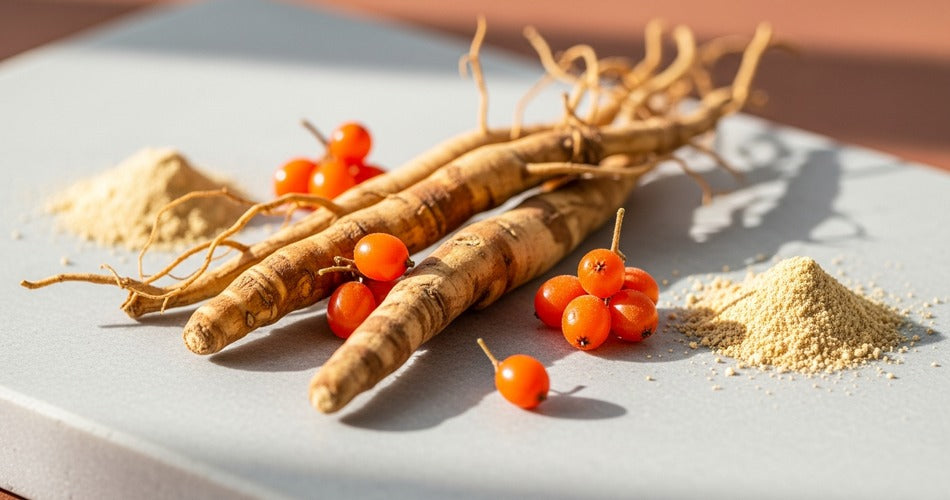
Ashwagandha enthält thermolabile (wärmeemp findliche) Withanolide UND einen Lipidfraktion bestehend aus Linolsäure, Palmitinsäure, Myristinsäure und Linolensäure, die die Hautbarrierengesundheit unterstützt. Die Extraktionsmethode bestimmt, was die Reise von der Wurzel zur Flasche übersteht.
- Überkritische CO2-Extraktion : volle Withanolid-Profile + Lipidfraktion konserviert. Kein Lösungsmittelrückstand. Gold-Standard für kosmetische Botanica.
- Ethanol-Extraktion : am häufigsten; potenter als Wasser, aber Hitze und Lösungsmittelrückstände beeinträchtigen thermolabile Withanolide. Spuren von Ethanol können gereizte Hautbarrieren irritieren.
- Wasser-Extraktion : billig; nur wasserlösliche Verbindungen extrahiert. Lipidfraktion verloren. Niedrigste Withanolid-Stärke für Hautanwendung.
Über die Extraktionsmethode hinaus sind einige Etikettensignale wichtig. Die Withanolid-Standardisierungsprozentuale ist die erste: Suche nach 2,5% oder höher, oder einer KSM-66-Referenz. INCI-Listenplatzierung ist die zweite: Obere Hälfte der Zutatenliste bedeutet sinnvolle Konzentration, nicht eine Fee-Bestäubung am Ende.
Unterstützende Wirkstoffe sind auch wichtig. Ashwagandha paart sich gut mit Niacinamid, Peptiden und lipidreichen Pflanzenölen. Eine Formel, die diese kombiniert, leistet mehr Arbeit als Ashwagandha allein.
Sobald du ein Produkt gefunden hast, das es wert ist, verwendet zu werden, ist die letzte Frage die, die die meisten Frauen falsch machen, und es ist der Grund, warum so viele aufgeben, bevor Ashwagandha eine Chance hat, zu wirken.
Realistische Zeitrahmen: Wann du tatsächlich Resultate sehen wirst
Die meisten Frauen, die Ashwagandha-Hautpflege versuchen, geben irgendwo zwischen Woche zwei und Woche vier auf. Nicht, weil es nicht funktioniert. Weil niemand ihnen sagte, wie "funktionieren" in diesem Stadium aussieht.
Wochen zwei bis vier sind über das Gefühl. Weniger reaktive Haut. Etwas mehr Spannkraft. Weniger Austrocknung auf den Wangen bis Mitte des Nachmittags. Das ist die Barrieren- und Antioxidans-Geschichte, die zuerst ihre Arbeit leistet, denn dies sind die am schnellsten reagierenden Systeme in deiner Haut (Danucera Ästhetiker).
Wochen sechs bis 12 sind, wo die strukturelle Verschiebung passiert. Elastizität. Fältchen-Milderung. Ton-Evenness. Das ist, wo die Kollagensynthese-Zeitrahmen tatsächlich funktionieren. Die 60-Tage-RCT maß Resultate am frühen Ende dieses Fensters, und das ist kein Zufall. Pigmentierungsmilderung (der Withaferin A zu MITF zu Tyrosinase-Weg) lebt auch hier.
Die Haut, die du in Woche vier spürst, ist nicht die Haut, die du in Woche 12 siehst.
Erwarte noch eine Sache, besonders wenn du Mischhaut hast. Ashwagandha verhält sich adaptogen auf Talg. Es neigt dazu, das Öl auf trockener Haut zu erhöhen und auf fettiger Haut zu verringern, nach Formulierer Zara Murthy. Deine Haut kann sich "normalisieren" eher als sich in eine Richtung zu schwingen. Das ist nicht ein Fehler. Das ist, was Adaptogene tun.
Wie man es verwendet. Morgens und abends, auf sauberer Haut, vor schwereren Ölen oder Feuchtigkeitscremes, wenn es in einem Serum ist. Es paart sich gut mit Peptiden und Niacinamid in der gleichen Routine. Tägliche Sonnenschutz ist nicht verhandelbar, wenn du topisches Ashwagandha verwendest, weil es mild photosensitiv Potenzial gibt (Dr. Leslie Baumann).
Echte Inhaltsstoffe wirken auf echte Biologie, und echte Biologie ist selten schnell. Aber sie ist treu, wenn du ihr die Zeit gibst, die sie wirklich braucht.