 Account



Calendula for skin is one of the oldest documented remedies in European herbalism, and it works through three routes at once: calming inflammation, supporting the moisture barrier, and soothing reactive skin. The plant is Calendula officinalis, also called pot marigold, native to the Mediterranean region and grown worldwide since. Its properties were recorded centuries before anyone could measure them.
There is a morning many women recognize, when a trusted balm just stops working. Same product, same routine, but skin feels thinner, drier, and strangely unfamiliar. If you have crossed the menopausal divide, you know exactly what that means.
Your skin is not damaged. It is fundamentally different now.
What follows is the compound chemistry, the honest state of the evidence, and the one extraction method that changes how much of this plant actually reaches your skin.
What Makes Calendula Extract So Effective on Aging Skin
Calendula works on several fronts because it carries several distinct compound classes, not one hero molecule. Each targets a different thing that happens to skin after estrogen starts declining.
Faradiol esters are the fraction most responsible for its anti-inflammatory properties. When researchers tested several calendula preparations made by supercritical CO2 extraction, the ones highest in faradiol monoesters produced the greatest reduction in inflammation. That is a dose-response relationship, which is stronger evidence than a compound simply being present.
This matters after menopause because post-menopausal skin sits in a state of chronic, low-grade inflammation that researchers call inflammaging.
Flavonoids including quercetin, isorhamnetin and kaempferol provide antioxidant defense. They scavenge the free radicals that build up faster as your skin's own defenses weaken, and that accumulation is part of what drives premature aging.
Triterpenoid saponins, including calenduloside and oleanolic acid glycosides, inhibit MMP enzymes. MMPs are the collagenases that break down existing collagen fibers, so slowing them protects what you already have.
Carotenoids give calendula flowers their orange pigment and contribute antioxidant support. Tannins have an astringent action that helps the barrier hold moisture, and small amounts of essential oils round out the profile.
Research published in Cosmetics on calendula's anti-inflammatory activity found the extract inhibits nitric oxide production through the iNOS pathway, in a dose-dependent way and without harming cell viability. The authors point to rosacea, melasma, vitiligo and both allergic and irritant contact dermatitis as conditions where that pathway is dysregulated.
This was laboratory work in immune cells rather than a trial on skin, but it explains the mechanism behind calendula's long record in soothing cosmetics for sensitive skin.
What Calendula Has Traditionally Been Used For
Long before the lab work, calendula was a household plant with a job. Marigold flowers were dried into salves and ointments, steeped into bath water for irritated skin, and used in folk practice for minor wounds and burns.
The petals also served as a coloring agent in food, standing in for saffron. Gardeners still grow their own calendula for exactly these reasons.
That history matters for one practical reason: it tells you which uses have centuries of observation behind them, and which are newer marketing.
Collagen Support: What the Research Actually Shows
Calendula supports skin firmness, and the honest version of that claim is narrower than most articles admit. Here is what holds up.
The Dual Mechanism
Calendula's triterpenoid saponins inhibit matrix metalloproteinases, the enzymes that degrade existing collagen. Its flavonoids reduce the oxidative stress that triggers those enzymes in the first place.
If firmness is your main concern, our collagen-boosting skincare balms are built around botanicals that work this way.
The Honest Context
A widely circulated statistic claims calendula increases procollagen synthesis by 83.7%. That figure comes from a 2018 study on Tagetes erecta, a different plant that also goes by the common name marigold.
We are not repeating it here, because Tagetes and Calendula officinalis are separate species with different chemistry. If you see that number attached to calendula elsewhere, it has been misattributed.
What Human Evidence Exists
The best human evidence comes from a 2011 study where 21 volunteers used a 3% calendula cream on their cheeks every day for eight weeks. A device called a Cutometer measured how their skin actually responded, rather than asking them how it felt.
Two things improved by a meaningful margin: firmness and hydration. Five other measurements stayed flat.
The volunteers were in their twenties and thirties. So the study shows calendula does something real on human skin, but it does not tell you how much it does on skin at 55.
That is worth knowing rather than glossing over. Calendula earns its place in a formula, and it works alongside other botanicals rather than carrying the whole load.
Barrier Repair and Deep Moisture for Thinning Skin
The moment your reliable balm stops working is not random. It is biological.
After menopause, estrogen decline reduces sebum output, thins the outer barrier, and increases transepidermal water loss. Your skin is losing water faster than it did five years ago, and formulas built for younger skin were not designed for that.
Calendula addresses this through several compounds working together. Tannins tighten intercellular junctions in the stratum corneum, slowing the rate moisture escapes. Calendic acid, an unsaturated fatty acid distinctive to calendula, supports lipid barrier reconstruction, while the plant's mucilage holds water at the surface.
The Akhtar 2011 trial measured this objectively. The improvement in the R0 hydration parameter was instrument data, not how skin felt.
Paired with organic beeswax, a nourishing occlusive that locks moisture in without water or fillers, the effect is a barrier that stays soft rather than tight. That combination sits at the center of our barrier repair for sensitive skin collection.
Calming Inflammation and Redness Without Steroids
Rosacea flare-ups. Unexplained redness. Skin that reacts to things it tolerated for years.
Calendula settles this through three distinct anti-inflammatory routes. Faradiol esters modulate the NFkB pathway and reduce IL-6 production. Flavonoids neutralize the reactive oxygen species that trigger inflammatory cascades, and triterpenoid saponins provide direct anti-edema action.
A systematic review of calendula for wound healing examined 14 studies, seven in animals and seven in humans. Faster resolution of the inflammation phase was consistent across five animal studies and one randomized trial, while results in chronic wounds and burns were mixed.
That is a real signal with honest limits, and it is a more useful picture than the confident claims usually made for this plant.
Unlike topical steroids prescribed for eczema and rosacea, calendula does not thin skin with long-term use. For post-menopausal skin already thinning from estrogen loss, that distinction matters.
This is exactly why calendula sits near the top of the ingredient list in our Balm for Acne-Prone Skin. It appears as Marigold (Calendula) Flower Extract, second only to the carrier oil, and it does the calming work while organic beeswax holds a protective layer over skin that has stopped tolerating things it used to.
Wound Healing and Skin Conditions Beyond Redness
Calendula's oldest documented use is wound healing, and this is where most of its clinical research sits. Traditional practice used it on grazes, chapping, and rashes.
Laboratory and animal work shows calendula accelerates epithelial tissue growth and encourages localized blood flow to the area, which is the mechanism behind faster granulation. It also shows antimicrobial activity in laboratory testing, though that is not the same as preventing infection in practice.
Calendula ointment has been studied for diaper dermatitis in infants, and it appears in many diaper rash creams for babies. In one triple-blind trial of 73 children under two, a 1.5% calendula ointment performed comparably to olive ointment, with no adverse effects in either group.
It is widely tolerated, which is the honest takeaway rather than proof of superiority.
For chronic skin conditions including psoriasis and eczema, the evidence is thinner. Calendula soothes and supports rather than resolves, and anyone managing a diagnosed condition should work with their doctor.
CO2 Extract vs. Infused Oil: Why the Extraction Method Changes Everything
Two products can both say calendula on the label and deliver very different amounts of it. The extraction method is the reason.
Three Extraction Methods Compared
Infused oil is the most common form. Dried flowers steep in a carrier oil such as sunflower or olive for weeks, which pulls some lipophilic compounds but dilutes them heavily. It typically appears at 5 to 10% in a formula.
CO2 supercritical extract uses pressurized carbon dioxide to strip lipophilic compounds directly from the flowers, with no carrier and no solvent residue. The result is a concentrated waxy paste used at just 0.1 to 0.3%.
Glycerite or tincture captures water-soluble compounds instead, and tinctures usually carry alcohol. That is a different profile entirely, and not comparable for the lipophilic actives that drive calendula's benefits on skin.
The Potency Gap Is Measurable
The clearest sign of the gap is the use rate. Infused oil goes into a formula at 5 to 10%, while CO2 extract does the job at 0.1 to 0.3%, because most of what is in an infused bottle is carrier oil.
Researchers working with Calendula officinalis also used supercritical technology to concentrate three of its antioxidants, chlorogenic, caffeic and ferulic acid, reaching levels 40 to 70% above the original extract.
Concentration is only half the story. Calendula oil and extracts both degrade with light and heat, so store calendula products in a cool, dark place to extend their shelf life.
The Label Problem
You cannot tell CO2 extract from infused oil by reading an ingredient list. Both carry the same INCI name: Calendula Officinalis Flower Extract.
To identify a genuine CO2 extract, look for brands that state supercritical CO2 extraction explicitly on the product page. If a carrier oil sits next to calendula in the list, it is almost certainly an infused oil.
One more check worth doing on any cosmetics label: confirm the species is Calendula officinalis, not Tagetes. Both are sold as marigold, and only one has the safety and efficacy record described here.
Ingredient Pairings That Amplify Calendula's Benefits
Calendula works on its own. The right companions make it work harder on mature skin, and these four show up together in well-built formulas for a reason:
- Sea buckthorn oil is the strongest pairing. Rich in omega-7, it supports lipid repair while calendula handles inflammation, and both are carotenoid-rich so their antioxidant activity overlaps. Our guide to sea buckthorn oil benefits covers why that combination suits skin after 45.
- Organic beeswax is what holds the rest in place. It forms a protective layer that keeps calendula's compounds against your skin instead of letting them evaporate off, which is also why a waterless balm outperforms a watery formula carrying the same botanical.
- Rosehip oil brings linoleic acid and natural carotenoids that support tone and texture. You will see rosehip marketed as natural retinol, which overstates it: the trace retinoic acid it contains sits far below any functional retinoid dose.
- Chamomile is another member of the aster family with complementary calming pathways. Together the two provide broad soothing without synthetic actives.
When you assess a facial oil or balm, look at what surrounds the calendula. A well-built formula pairs it with complementary lipids and antioxidants rather than leaving it to work alone.
How to Use Calendula Extract in Your Daily Routine
Use calendula twice daily, morning and night, on clean skin. Calendula oil and balms are both suited to this rhythm, and consistency matters more than concentration.
Morning

Start with a day balm on clean skin. The Anti-Age & Insane Glow Day Balm carries calendula alongside sea buckthorn and pomegranate, which is the pairing described above. If your skin is acne-prone or combination, the Magic Revive & Glow Day Balm carries the same botanical in a lighter formula.
A fingertip amount is enough with waterless formulas. If your skin looks orange, you have used too much.
Frøya Organics does not treat daily sunscreen as mandatory, and moderate sun exposure has real benefits. For long stretches outdoors, a mineral sunscreen with zinc oxide is the option we recommend.
Evening

Apply your balm again at night. Evening is when skin repair peaks, so calendula's anti-inflammatory and barrier-supporting compounds align with your skin's own cycle.
For the eye area, the Magic Revive Eye Balm lists Marigold CO2 Extract, the supercritical form described above, paired with arnica for the thinnest skin on your face. If redness is your main concern, the Balm for Acne-Prone Skin carries calendula second on its label and works as a thin layer before bed.
Frøya Organics balms are designed as a complete standalone routine, not a layer to add on top of other skincare products. Fewer, more concentrated steps suit thinning skin better than a long stack.
Beyond the Face
Calendula is not only for your face. The décolletage, hands and forearms all show menopausal changes, and calendula applied topically suits all of them.
This is also where the plant's older forms still make sense. A calendula lotion, salve or balm on chapped hands does the same work it has always done.
Realistic Timeline
The Akhtar trial measured significant changes at eight weeks. You will likely notice immediate softness and soothing, but measurable improvements in firmness and hydration take consistent daily use over two months.
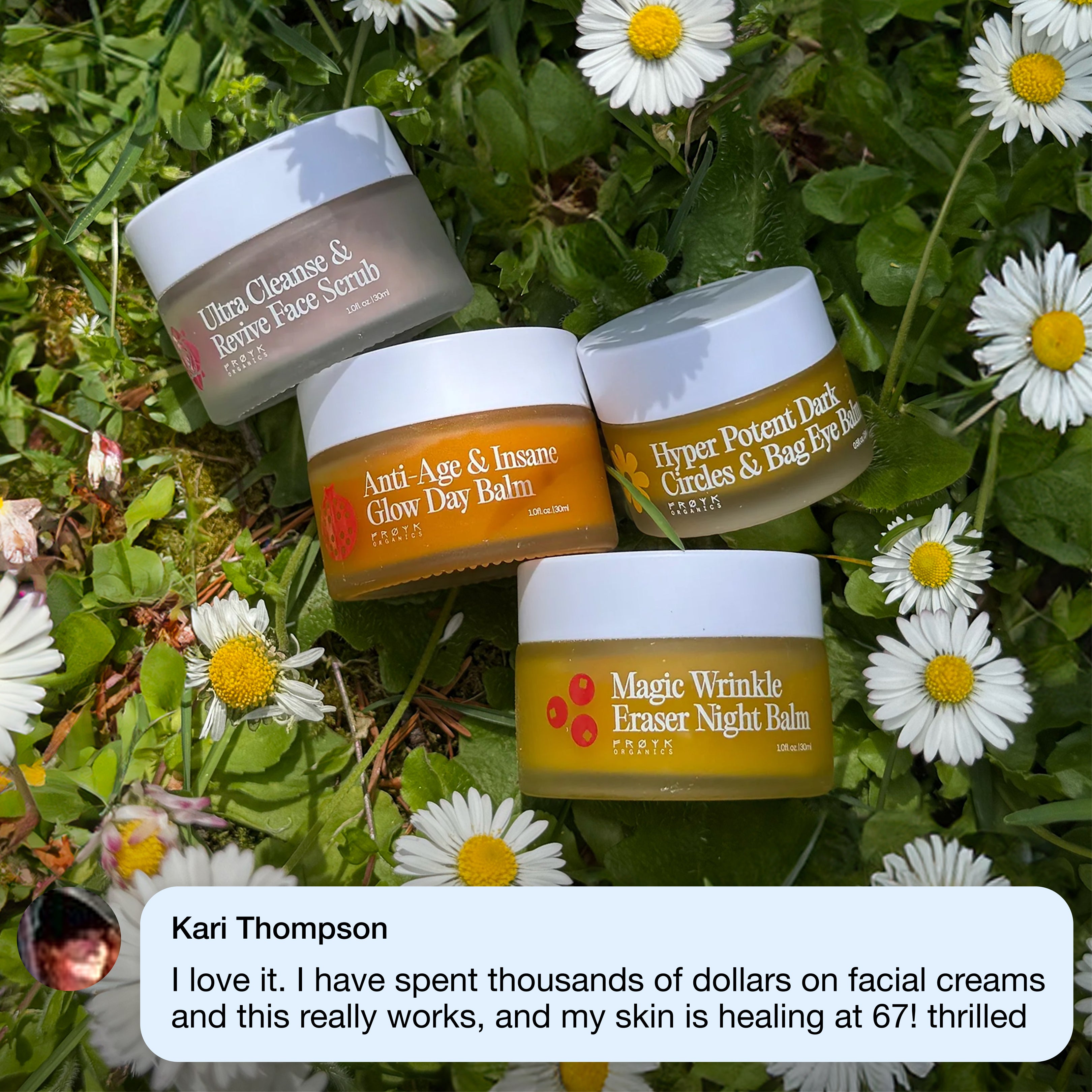
Wild Arctic botanicals and organic beeswax. Zero water, zero synthetic fragrance. Four balms in one routine that feed the barrier lipids a lasting glow depends on, backed by a 60-day money-back guarantee.
Shop the System - $119Frequently Asked Questions
Is calendula extract safe for rosacea-prone skin?+
How can I tell if a product contains real CO2 extract or just infused oil?+
When should I avoid calendula extract?+